



This box summarises the main findings from recent contacts between ECB staff and representatives of 79 leading non-financial companies operating in the euro area. The exchanges took place between 5 and 14 January 2026.[1]
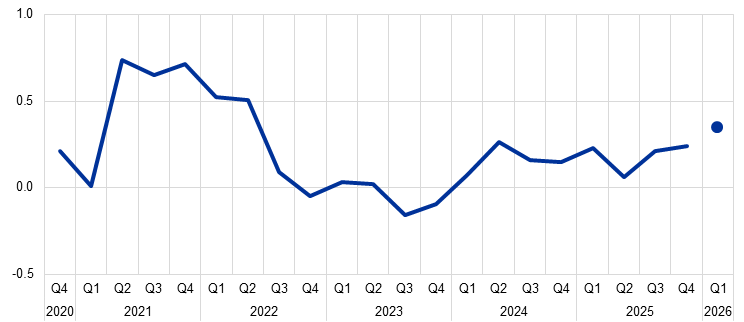
Contacts reported gradually increasing business momentum and confidence in recent months (Chart A and Chart B). Growth continued to be driven primarily by services activity, whereas reports in relation to industrial activity were mixed. Physical investment was picking up, but high energy, labour and regulatory costs still weighed on manufacturing amid intensifying competition, causing euro area firms to lose market shares in domestic and foreign markets. Varying labour and energy costs also helped to explain intra-euro area growth differentials.
Chart A
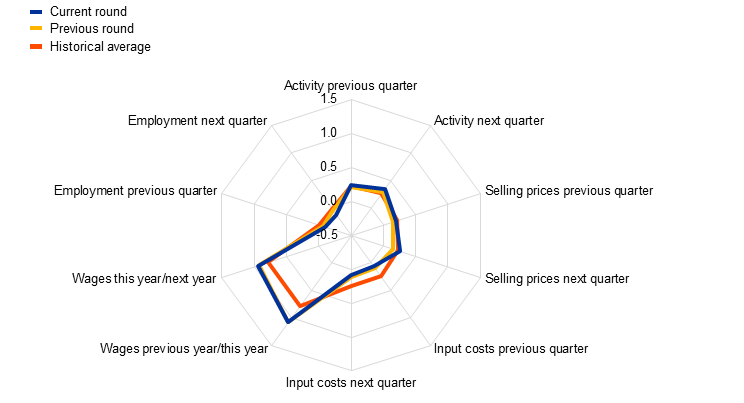
Summary of views on activity, employment, prices and costs
(averages of ECB staff scores)
Source: ECB.
Notes: The scores reflect the average of scores given by ECB staff in their assessment of what contacts said about quarter-on-quarter developments in activity (sales, production and orders), input costs (material, energy, transport, etc.) and selling prices, and about year-on-year wage developments. Scores range from -2 (significant decrease) to +2 (significant increase). A score of 0 would mean no change. For the current round, previous quarter and next quarter refer to the fourth quarter of 2025 and first quarter of 2026 respectively, while for the previous round these refer to the third and fourth quarters of 2025. Discussions with contacts in January and in March/April regarding wage developments normally focus on the outlook for the current year compared with the previous year, while discussions in June/July and September/October focus on the outlook for the next year compared with the current year. The historical average is an average of scores compiled using summaries of past contacts extending back to 2008.
Growth in consumer spending on services continued to outpace growth in spending on goods. Retailers reported disappointing spending in late 2025 amid intense price competition and weak consumer confidence. Spending was said to pick up sharply during promotion and discount periods, such as “Black Friday”, but otherwise tended to remain subdued. In food retail, traditional supermarkets were recovering some of their market share vis-à-vis discounters, but only by copying their pricing strategies. In clothing retail, spending at outlets was growing robustly in contrast to high street sales which had stagnated. The market for domestic appliances and consumer electronics was described as very tough, with subdued demand and increasing competition. Automotive sales remained relatively flat amid continued regulatory uncertainty. By contrast, consumer services spending continued to grow strongly, with a positive outlook. This applied in particular to tourism, supported by expanding capacity in the leisure industry. Contacts in healthcare and telecommunications also reported good growth in demand, with ageing populations and digitalisation being key drivers.
Chart B
Views on developments in and the outlook for activity
(averages of ECB staff scores)
Source: ECB.
Notes: The scores reflect the average of scores given by ECB staff in their assessment of what contacts said about quarter-on-quarter developments in activity (sales, production and orders). Scores range from -2 (significant decrease) to +2 (significant increase). A score of 0 would mean no change. The dot refers to expectations for the next quarter.
According to contacts, the investment outlook was gradually improving. Manufacturers of machinery and equipment pointed to improving order books, especially for projects related to electrification, data centres, energy and defence. Increasing orders for machinery were also linked to construction firms gearing up for the anticipated increase in public infrastructure spending in Germany, albeit this spending would only properly get underway in late 2026 or in 2027. Contacts in or suppliers to the construction sector also pointed to improving order books, albeit with growth in infrastructure and commercial construction more consistently positive than residential construction, where lack of land and labour hindered a stronger recovery. Contacts that provided digital services reported continued strong, and even increasing, growth in demand for cloud services and (other) AI-related investment, as well as in cybersecurity, with a particularly strong increase in demand from the public sector, aerospace and defence, life science, insurance, energy and telecommunications. The focus on AI investment also reflected firms desire to cut costs, which increasingly involved using AI to reduce research and development (R&D) costs.
Global trade was proving resilient to US tariffs so far, but euro area net trade was suffering from trade diversion, clouding the outlook somewhat. According to contacts in the shipping industry, growth in global trade seemed unaffected by the increase in US tariffs, but there had been rapid and significant changes in trade flows. This included strong growth in intra-Asian trade and in imports to the euro area, especially from China, and flat or contracting euro area exports in recent months. Many contacts in the manufacturing sector reported losing market shares to Chinese competitors whether in the euro area, in China or in other markets. This reflected significant losses in the cost competitiveness of euro area firms since the pandemic caused by significant increases in labour, energy and regulatory costs, exacerbated by the appreciation of the euro. A cohesive EU industrial strategy to respond to these challenges was seen as important to regain confidence about the outlook, notwithstanding the forthcoming boost expected to come from fiscal stimulus.
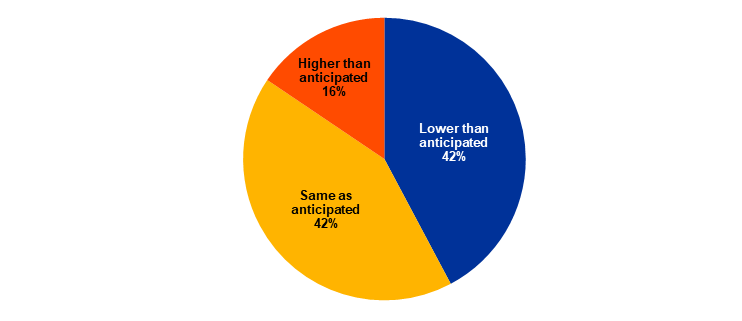
The impact of US tariff increases in 2025 was said by most to have been the same as – or lower than – anticipated. Roughly two-fifths of contacts who considered their firm or sector to be affected by the US tariffs said the impact had been lower than anticipated, less than half that number thought the opposite and roughly the same number said the impact was the same as anticipated (Chart C). Reasons cited for a lower impact included (i) a degree of frontloading and opportunities during 2025 to avoid the US tariffs; (ii) a rapid reorientation of global trade, with the rest of the world becoming more integrated; (iii) significant absorption of the impact by US importers fearful of reactions from the US government; (iv) an offsetting impact from the AI boom; and (v) resilience of US consumer spending driven by higher income households.
Chart C
The impact of US tariffs relative to prior expectations
(percentage of responses)
Source: ECB.
Note: This chart summarises the responses of contacts from 45 firms who considered the US tariffs relevant for their firm or sector.
The employment outlook remained lacklustre amid a strong focus on cost-cutting and increasing AI-enabled work process optimisation. Firms in parts of the manufacturing sector, particularly in the chemicals and automotive industries, and mainly in core euro area countries, continued to make sizeable job cuts owing to sustained weak demand, high costs and intensifying import competition. Companies in these sectors were consolidating production, relocating functions to lower cost regions and restructuring white-collar and R&D roles, drawing on AI tools and automation to reap efficiency gains. By contrast, contacts in consumer services, particularly in hospitality and air travel, reported rising employment tied to growing demand. In most other sectors, contacts reported employment being rather flat, in part because the increasing integration of AI into work processes had enabled businesses to grow without needing more staff. AI was also reshaping and replacing some white-collar roles, resulting in a difficult job market for graduates. Recruitment challenges persisted, however, for many specialised roles, particularly in sectors such as energy, construction, cybersecurity, aerospace and defence. Placement agencies said that temporary placement activity seemed to have reached a trough, but permanent hiring had continued to fall. The consensus outlook for 2026 was for a return to modest staffing growth, but there were no clear indications this had yet begun.
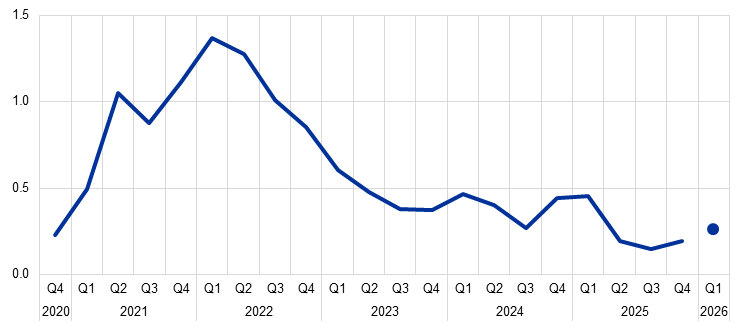
Growth in selling prices had remained moderate, with recent trends broadly expected to persist in the short term (Chart A and Chart D). Price growth continued to be driven by services, including food retail, transport, tourism, hospitality, telecommunications, real estate and AI-related services. Particularly in consumer services, contacts said that their firms could increase prices at quite good rates, still benefiting from customers’ willingness to spend, although some anticipated more resistance in the future. Contacts in the non-food retail sector and in manufacturing, by contrast, reported rather stable prices, with many describing prices as “under pressure”. In these sectors, upward price and cost pressure from wages and regulation were counterbalanced by downward pressure from increasing import competition. For upstream manufacturers, this typically put downward pressure on both prices and margins, while downstream manufacturers also benefited from lower input prices, neutralising the impact on their margins. In construction, being much less exposed to global competition, contacts reported rising prices linked to increasing labour and construction material costs.
Chart D
Views on developments in and the outlook for prices
(averages of ECB staff scores)
Source: ECB.
Notes: The scores reflect the average of scores given by ECB staff in their assessment of what contacts said about quarter-on-quarter developments in selling prices. Scores range from -2 (significant decrease) to +2 (significant increase). A score of 0 would mean no change. The dot refers to expectations for the next quarter.
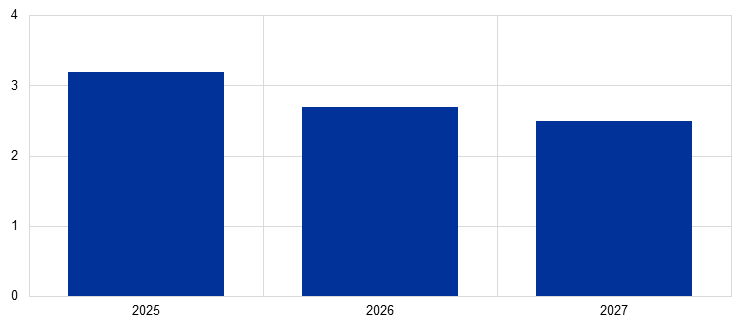
Contacts continued to anticipate moderating wage growth (Chart E). On average, the quantitative indications provided would imply that wage growth is expected to slow, from 3.2% in 2025 to 2.7% in 2026 (0.1% lower and 0.1% higher, respectively, than in the previous survey round) and to 2.5% in 2027.
Chart E
Quantitative assessment of wage growth
(percentages)
Source: ECB.
Notes: Averages of contacts’ perceptions of wage growth in their sector in 2025 and their expectations for 2026 and 2027. The averages for 2025, 2026 and 2027 are based on indications provided by 68, 70 and 33 respondents respectively.
References
Elding, C., Morris, R. and Slavík, M. (2021), “The ECB’s dialogue with non-financial companies”, Economic Bulletin, Issue 1, ECB.
For further information on the nature and purpose of these contacts, see Elding, Morris and Slavík (2021).